A short history of 90s RTS: how the genre rose, faded and came back
For about a decade, real-time strategy was the biggest thing on PC. Then it almost vanished. Here is the short version of what happened, and why the harvesters are rolling again.
On this page
Before the boom (1983–1991)
Real-time battles on computers go back to the early 1980s: Stonkers (1983) on the ZX Spectrum and The Ancient Art of War (1984) on PC let you command armies without taking turns. The game most often called the first real RTS is Herzog Zwei (1989) on the Sega Mega Drive: two players, bases, unit production and a transforming jet you used to ferry troops. It was a cult hit, and it is often cited as an influence on what came next.
The formula is born: Dune II (1992)
Westwood Studios' Dune II put the pieces together: a construction yard, buildings placed on a grid, a harvester collecting spice and driving it back to a refinery, a tech tree, three factions and a mouse-driven interface. Almost every RTS since is a variation on it.
The golden age (1994–2002)
- Warcraft: Orcs & Humans (1994) and Warcraft II (1995) from Blizzard brought fantasy, two-player modem and LAN battles, and personality: units talked back when you clicked them too often.
- Command & Conquer (1995) made the genre a phenomenon: full-motion video briefings with real actors, a near-future war over the alien crystal Tiberium, the sidebar build menu and a superweapon you could see coming. Red Alert (1996) moved it into an alternate-history Cold War.
- Total Annihilation (1997) went 3D, with real terrain, ballistics, a continuous economy and enormous armies. Age of Empires (1997) used real history as its setting.
- StarCraft (1998) perfected asymmetric design with three races that shared almost nothing, and in South Korea it became the first great esport, with televised leagues and professional players.
- Age of Empires II (1999), Tiberian Sun (1999) and Homeworld (1999) pushed depth, darker sci-fi and full 3D space.
- Red Alert 2 (2000) was bright, fast and funny, and for many players it is still the favourite.
- Warcraft III (2002) added heroes and upkeep, and its custom map editor produced Defense of the Ancients, which would change everything.
The quiet years (2003–2016)
In 2003 EA closed Westwood Studios. Good RTS games kept coming, including Command & Conquer: Generals (2003), Company of Heroes (2006), Supreme Commander (2007) and StarCraft II (2010), but the audience was moving.
- MOBAs took the competitive crowd. DotA, born as a Warcraft III map, and then League of Legends (2009) kept the hero and the lane and dropped the base and the economy. Easier to start, social, free.
- Publishers chased consoles. RTS games need a pointer and many commands; a gamepad is awkward, and publishers followed the money to shooters.
- The skill gap became a wall. Watching professionals play StarCraft II at hundreds of actions per minute was thrilling and also intimidating. Many players never queued for ranked at all.
- Big franchises stumbled. Command & Conquer 4 (2010) changed the formula and was poorly received; the series went quiet on PC.
The comeback (2017–today)
The genre did not die; it was waiting for its players to come back.
- Remasters: StarCraft: Remastered and a free original StarCraft (2017), the Age of Empires Definitive Editions (2018–2019), the Command & Conquer Remastered Collection and Warcraft III: Reforged (2020), and Warcraft I & II remasters (2024).
- New big games: Age of Empires IV (2021) and its console releases, Age of Mythology: Retold (2024).
- Indies and veterans: Tempest Rising (2025) revived the Westwood style; Stormgate came from former StarCraft II developers; open-source projects like Beyond All Reason grew large communities; Steam began hosting an annual RTS festival.
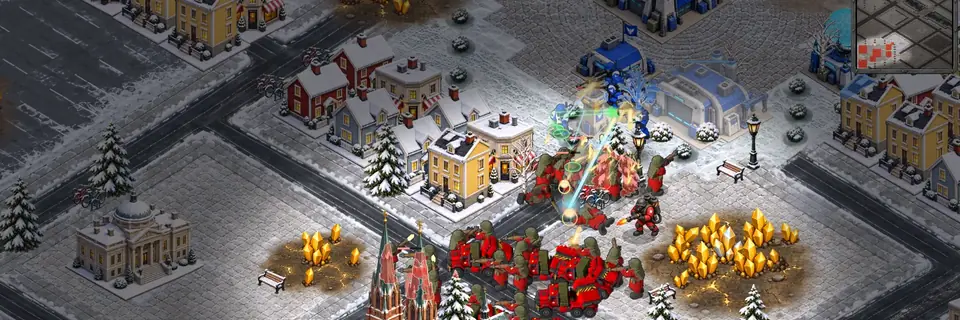
- New places to play: WebAssembly made full RTS engines possible in a browser, and phones became powerful enough to run them. That is where our own game, Frontier: Cold Front, comes in: a 90s-style base builder designed to be played with one thumb on a phone as well as with a mouse on PC.
What the classics still teach
The games people remember from the 90s were not the most complex. They were the ones with readable rules (you could see your economy driving around), sides with a personality, a sense of humour, and matches short enough for one more. That is a recipe any new RTS can follow.
Frequently asked questions
What was the first RTS game?
It depends on the definition. Stonkers (1983) and The Ancient Art of War (1984) had real-time battles, Herzog Zwei (1989) on the Sega Mega Drive is often called the first RTS, and Dune II (1992) established the formula of harvesting, base building and factions that the genre still uses.
Why did RTS games become less popular?
A mix of reasons: MOBAs like DotA and League of Legends took the competitive audience, publishers moved to console-friendly genres, Westwood Studios was closed in 2003, and competitive RTS gained a reputation for being very hard to get into.
Are RTS games coming back?
Yes, on a smaller scale: remasters of the classics since 2017, Age of Empires IV in 2021, new indie RTS games like Tempest Rising in 2025, Steam's annual RTS festival, and RTS games that run in browsers and on phones.
All game names, trademarks and logos mentioned here belong to their owners and are used only to identify the games. Frontier: Cold Front is an independent game by Rick-y Media AB and is not affiliated with, endorsed by or sponsored by Electronic Arts, Blizzard Entertainment, Microsoft or any other company named on this page.
Keep reading
- Classic RTS gamesThe landmark 90s RTS games, how to play them legally today, and modern games in the same spirit.
- Games like Red Alert 2The original, its browser remake, Tempest Rising, free remakes and new RTS with the same swagger.
 Games like Command & ConquerRemasters, freeware originals, Tempest Rising and other RTS with the Westwood DNA.
 RTS glossaryAPM, macro, micro, rush, turtle, creep, kiting, supply block and more, in plain English.